The #1 Prompt Monitoring Tool
Real-Time Prompt Monitoring
in 
See what ChatGPT and other AI models say about you —and how to rank your brand in every AI conversation.
Trusted by Leading Brands for Prompt Monitoring Tool Insights
Powering the Best Teams


.png%3F2026-02-10T12%253A58%253A43.374Z&w=3840&q=75)


Prompts Monitoring and Tracking
Use prompt monitoring to track which queries generate brand mentions and influence your AI search visibility across leading AI platforms.

Query Discovery
Identify exact prompts generating brand mentions across ChatGPT, Claude, Perplexity, and Gemini.
Prompt Performance
Monitor which query types consistently trigger citations versus queries where you're invisible.
Intent-Based Prompt
Segment prompts by customer intent—informational, comparison or technical queries automatically.
Historical Prompt
Track which prompts gain or lose citation frequency over time systematically.
Understand how ChatGPT, Google AI, Gemini, and other AI platforms access your website and shape your AI search visibility.
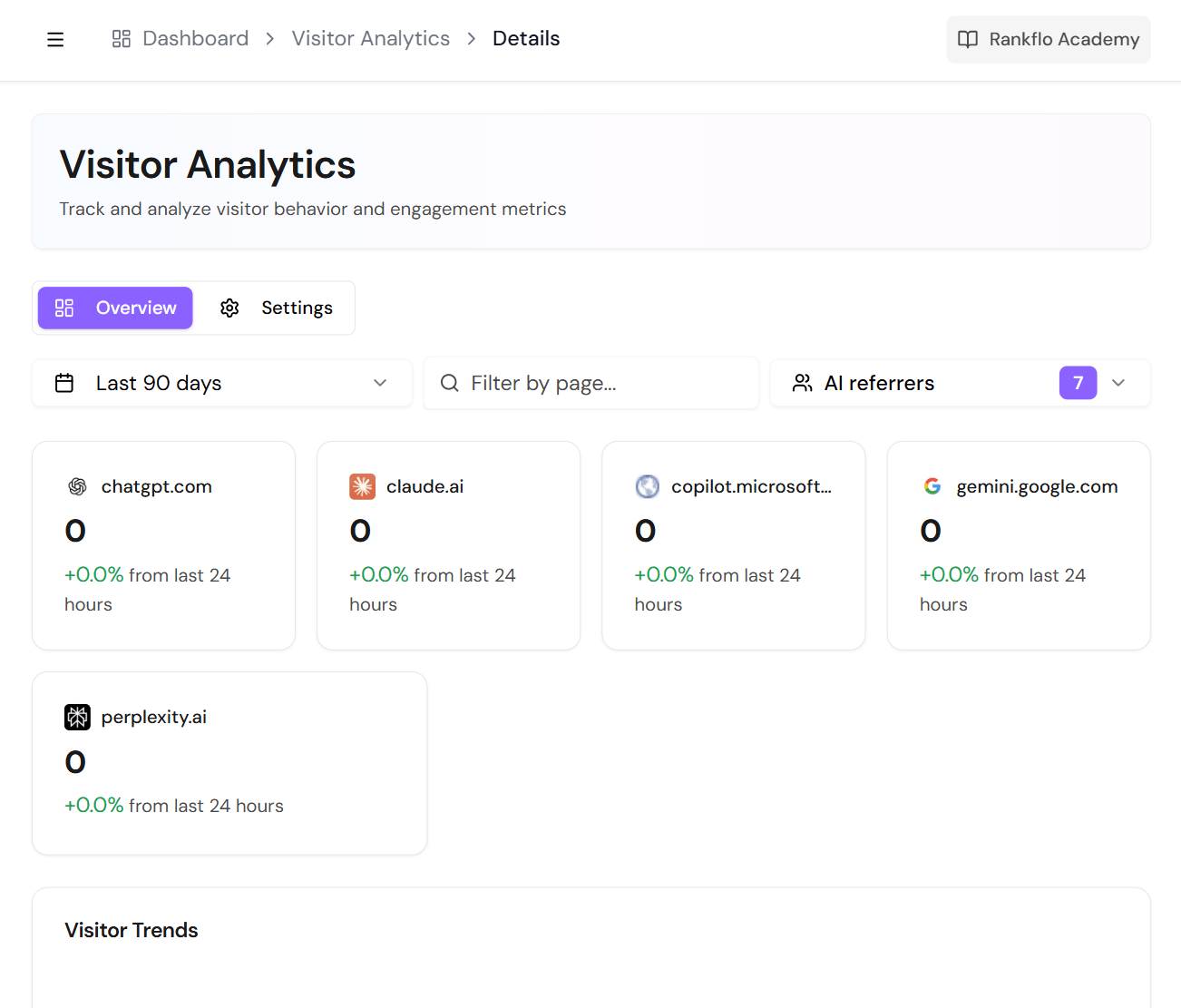
Identify where your brand can be cited in AI responses and improve your brand visibility with Rankflo's prompt monitoring tool.
-2.png&w=1920&q=90)
Real-time Visitor Analysis
Monitor your prompt performance analytics in real-time with data from different AI Models.
Monitor Competitor Visibility Across AI Search Engines
Track how competitors appear in AI-generated responses and uncover gaps in your brand’s AI search presence by monitoring prompt-driven mentions.

Competitive Benchmarking
Monitor your visibility against competitors by comparing prompt mentions across different AI platforms.
Rival Mentions
Track when competitors are mentioned in AI responses and see how they rank for key prompts.
Market Share Analysis
Use prompt monitoring to visualize your share of AI search visibility compared to competitors in AI chats.
1v1 Comparisons
Compare your brand’s visibility side-by-side with competitors across multiple AI models using prompt-based data.
Why Choose Our Solution
Discover the key features that set our platform apart from the competition.
Advanced Analytics

Get detailed insights into your performance with our comprehensive analytics dashboard.
Easy Integration
Seamlessly integrate with your existing tools and workflows in minutes.
Track prompt monitoring data across languages and regional variations.
-3.png&w=1920&q=90)
Control how your brand responds to different prompt categories.
-4.png&w=1920&q=90)
Real prompt response data from actual AI platforms
See how ChatGPT, Claude, and other AI models genuinely respond to your tracked prompts. Authentic testing results from live AI interfaces, not simulated API responses.


.png%3F2026-02-17T07%253A33%253A26.860Z&w=3840&q=75)
-7.png%3F2026-04-01T10%253A42%253A58.133Z&w=3840&q=75)
IMPACTS
Built for Scaling Teams
Rankflo helps you optimize for where search is actually happening—ChatGPT, Claude, Perplexity, and other AI search engines that already influence 40%+ of purchase decisions in high-value categories.


Dominate AI Search Now
Rankflo AI prompt tracking tool help you to monitor prompt in AI models like ChatGPT, Claude, Gemini, Perplexity, and others. Stop being invisible to AI platforms. Start getting mentioned where your audience is searching daily.

The Ultimate Guide to Prompt Monitoring Tool
Start using Rankflo AI prompt monitoring tool to track how ChatGPT, Gemini, Claude, and other AI platforms responses about you and your competitor.
The Ultimate Guide to Prompt Monitoring Tool
/| Rankflo
On this page
Track AI Prompts
Improve your brand mentions in ChatGPT, Gemini, Claude, and other AI search engines.
Book a DemoA prompt monitoring tool helps you systematically track, analyze, and understand how prompts are used across AI systems and how those prompts influence AI search visibility. Instead of manually guessing which prompts work best, a prompt monitoring tool gives you structured insight into prompt performance, AI response behavior, and how often your brand appears in AI-generated answers.
At its core, prompt monitoring means logging prompt inputs, identifying patterns, and measuring which prompts generate brand mentions, citations, or traffic-driving responses across AI platforms like ChatGPT, Google AI, Gemini, Claude, and others. A prompt tracking tool helps manage this data so you can optimize your strategy over time.
AI is changing how people discover products, compare brands, and make buying decisions. Instead of only searching Google, users now ask AI tools for recommendations, summaries, alternatives, and expert answers. That means your brand visibility depends not only on traditional SEO but also on how often AI systems mention, cite, or recommend you. A prompt monitoring tool helps you track that visibility and understand where your brand stands inside AI-generated responses.
Understand AI Visibility
Prompt monitoring helps you see which prompts trigger your brand mention and which prompts surface your competitors instead. This gives you a clearer picture of how AI platforms understand your brand, category, and authority.
Without this visibility, you may assume your brand is showing up when users ask relevant questions, but AI responses may tell a different story. By tracking these prompts regularly, you can identify gaps and improve the content that influences AI-generated answers.
Discover Competitor Visibility Gaps
AI platforms often compare multiple brands in a single response. Prompt monitoring shows whether your competitors are being recommended more often, cited more frequently, or described more clearly than your brand.
This helps you find prompts where competitors are winning and your brand is missing. Once you know the gap, you can create better comparison pages, product content, use-case pages, and authority signals to improve your position.
Track Your Rank in AI LLMs
Traditional rank tracking shows where your website appears in search results, but AI discovery works differently. You need to know whether your brand appears first, second, buried in the response, or not mentioned at all.
This is where an AI rank tracker becomes useful. It helps you monitor your brand’s position across AI-generated answers so you can measure visibility changes over time instead of relying on manual checks.
Improve Prompt Performance Over Time
Not all prompts have equal value. Some prompts are informational, while others show strong buying intent, such as “best software for agencies” or “top tools for local service businesses.”
Prompt monitoring helps you separate high-value prompts from low-impact ones. By analyzing which prompts generate mentions, citations, and stronger positioning, you can focus your optimization work where it has the highest business impact.
Get More Brand Exposure in AI Search
AI search is becoming a new discovery channel for brands. When users ask AI tools for recommendations, your brand needs to appear in the answer, not just rank somewhere on a traditional search page.
A prompt monitoring process helps you understand what content, entities, and citations influence your exposure. Over time, this helps you increase brand mentions, improve topical authority, and become more visible in AI search results.
Strengthen Answer Engine Optimization
An answer engine optimization tool focuses on making your brand easier for AI-powered answer systems to understand, trust, and recommend. Prompt monitoring supports this by showing which answers include your brand and which ones leave it out.
With this data, you can improve content structure, FAQs, comparison pages, schema, and citation-worthy resources. The goal is to make your brand a stronger candidate when AI systems generate direct answers for users.
Support Generative Engine Optimization
Generative engine optimization is about improving how your brand appears inside AI-generated responses across tools like ChatGPT, Gemini, Claude, Perplexity, and others. Prompt monitoring gives you the feedback loop needed to make that improvement measurable.
For example, a ChatGPT mention tracker can show whether your brand appears in ChatGPT responses for important prompts. Combined with broader prompt tracking, this helps you understand where your brand is gaining visibility and where more optimization is needed.
When choosing an AI prompt monitoring tool, focus on capabilities that give you clear visibility into how prompts impact your brand across AI platforms.
Prompt Logging & Tracking
Look for a tool that captures all relevant prompts — including those that generate no citations or visibility. This helps you identify missed opportunities, not just successes.
Performance Metrics
A strong prompt monitoring tool should measure how prompts perform over time. Key indicators include:
- How often prompts generate citations.
- Which AI platforms respond best.
- Changes in visibility trends.
These insights help you prioritize high-impact prompts and refine weaker ones.
Comparative Insights
Choose a tool that allows you to compare how different AI models respond to the same prompt. This reveals platform-specific differences in visibility and relevance.
Prompt Trend Analysis
Ensure the tool tracks prompt performance over time. Understanding which prompts are gaining or losing effectiveness helps you adapt your content and AI visibility strategy proactively.
Start using Rankflo AI prompt monitoring tool to find how your brand is getting mentioned, where, and when.
The field of prompt analytics is expanding rapidly. Future capabilities may include:
- Automated prompt optimization suggestions
- AI‑driven prompt templates for specific industries
- Predictive scoring of prompts before deployment
- Integrated prompt versioning and testing workflows
These advancements will make prompt tracking tools even more indispensable to digital teams.
These terms are related but distinct:
- Prompt Monitoring Tool: Focuses on tracking, visibility, and analytics — measuring what actually happens when prompts are used across AI platforms.
- Prompt Management Tool: Often more focused on versioning, storing, and testing prompt templates (commonly used by developers).
- Prompt Engineering: The practice of crafting prompts to get better AI results — more strategic than monitoring or management.
Understanding this helps you choose the right solution for your goals.
A prompt monitoring tool is useful for any business that depends on online discovery, brand trust, and competitive visibility. As more users rely on AI platforms to compare products, evaluate vendors, and find recommendations, brands need to understand how they appear inside AI-generated answers.
SaaS and software companies
SaaS companies can use prompt monitoring to track how often their products appear for category, comparison, and alternative-style prompts. For example, prompts like “best project management software,” “top CRM tools for agencies,” or “alternatives to [competitor]” can directly influence buyer decisions.
By monitoring these prompts, software brands can identify where they are being mentioned, where competitors are winning, and which content gaps need to be fixed. This helps SaaS teams improve product pages, comparison pages, feature pages, and educational content.
Agencies and marketing teams
Agencies can use prompt monitoring to measure AI visibility for their own brand and for client campaigns. Since AI search is becoming part of SEO, agencies need a way to show clients how their brand is performing across AI platforms.
A prompt monitoring tool helps agencies track brand mentions, competitor visibility, citations, and prompt-level performance. This gives them clearer reporting and stronger data for answer engine optimization and generative engine optimization strategies.
Ecommerce brands
Ecommerce brands can benefit from tracking prompts related to product recommendations, comparisons, and buying guides. Users increasingly ask AI tools questions like “best skincare products for dry skin” or “best ergonomic office chair under $300.”
If your products are not appearing in those AI-generated recommendations, you may be losing visibility before users even reach Google or a marketplace. Prompt monitoring helps ecommerce teams understand which prompts create product exposure and which ones need better content, reviews, or authority signals.
B2B service providers
B2B companies often depend on trust, expertise, and category authority. When potential buyers ask AI tools for the best consultants, software partners, agencies, or service providers, your brand needs to appear in the conversation.
Prompt monitoring helps B2B teams identify whether AI platforms understand their positioning correctly. It also reveals whether competitors are being recommended more often for high-intent prompts that matter to the sales pipeline.
Local and multi-location businesses
Local businesses can use prompt monitoring to understand how AI tools respond to location-based searches and recommendation prompts. This matters for businesses such as clinics, law firms, home service providers, restaurants, real estate firms, and local agencies.
For example, prompts like “best HVAC company in Dallas” or “top dental clinic near me” may influence local discovery. Tracking these prompts helps businesses understand where they appear, how they are described, and what competitors are being recommended instead.
Publishers and content brands
Publishers, media companies, and content-led businesses can use prompt monitoring to see whether AI platforms cite or summarize their content. This is especially important as AI tools increasingly answer informational queries directly.
By tracking which prompts generate citations, mentions, or summaries, publishers can understand which content assets have AI visibility. They can also identify topics where their authority is weak and improve content depth, structure, and source credibility.
Using a prompt monitoring tool is only the first step. To get real value, you need a clear strategy for choosing prompts, tracking performance, and turning insights into action.
Start by identifying the prompts your audience is likely to ask. These may include brand prompts, competitor prompts, category prompts, comparison prompts, problem-based prompts, and buying-intent prompts. The goal is to monitor the questions that could influence whether someone discovers, trusts, or chooses your brand.
Next, group your prompts by intent. Some prompts help you measure awareness, while others reveal buying-stage visibility. For example, “what is prompt monitoring” is informational, while “best prompt monitoring tool for SaaS brands” is much closer to purchase intent.
Then, track how your brand performs across different AI platforms. Your visibility may be strong in one model but weak in another. This matters because users do not rely on only one AI assistant, and each platform may generate different answers from different sources.
Finally, connect prompt monitoring insights to your content and SEO workflow. If your brand is missing from important prompts, create or improve content that directly supports those topics. This may include comparison pages, use-case pages, industry pages, FAQs, original research, help docs, and citation-worthy resources.
Prompt monitoring is becoming an essential part of modern AI visibility strategy. As users shift from traditional search results to AI-generated answers, brands need to know when they are being mentioned, where they are missing, and how competitors are appearing instead.
A prompt monitoring tool helps turn this new search behavior into measurable data. Instead of guessing how AI platforms describe your brand, you can track prompts, analyze responses, measure mentions, monitor citations, and improve your visibility over time.
For businesses investing in SEO, answer engine optimization, or generative engine optimization, prompt monitoring gives you the feedback loop needed to compete in AI search. The brands that understand this early will have a stronger chance of being cited, recommended, and remembered when users ask AI tools what to choose next.
What Is a Prompt Monitoring Tool?
A prompt monitoring tool helps you systematically track, analyze, and understand how prompts are used across AI systems and how those prompts influence AI search visibility. Instead of manually guessing which prompts work best, a prompt monitoring tool gives you structured insight into prompt performance, AI response behavior, and how often your brand appears in AI-generated answers.
At its core, prompt monitoring means logging prompt inputs, identifying patterns, and measuring which prompts generate brand mentions, citations, or traffic-driving responses across AI platforms like ChatGPT, Google AI, Gemini, Claude, and others. A prompt tracking tool helps manage this data so you can optimize your strategy over time.
Why Prompt Monitoring Matters for Your Brand?
AI is changing how people discover products, compare brands, and make buying decisions. Instead of only searching Google, users now ask AI tools for recommendations, summaries, alternatives, and expert answers. That means your brand visibility depends not only on traditional SEO but also on how often AI systems mention, cite, or recommend you. A prompt monitoring tool helps you track that visibility and understand where your brand stands inside AI-generated responses.
Understand AI Visibility
Prompt monitoring helps you see which prompts trigger your brand mention and which prompts surface your competitors instead. This gives you a clearer picture of how AI platforms understand your brand, category, and authority.
Without this visibility, you may assume your brand is showing up when users ask relevant questions, but AI responses may tell a different story. By tracking these prompts regularly, you can identify gaps and improve the content that influences AI-generated answers.
Discover Competitor Visibility Gaps
AI platforms often compare multiple brands in a single response. Prompt monitoring shows whether your competitors are being recommended more often, cited more frequently, or described more clearly than your brand.
This helps you find prompts where competitors are winning and your brand is missing. Once you know the gap, you can create better comparison pages, product content, use-case pages, and authority signals to improve your position.
Track Your Rank in AI LLMs
Traditional rank tracking shows where your website appears in search results, but AI discovery works differently. You need to know whether your brand appears first, second, buried in the response, or not mentioned at all.
This is where an AI rank tracker becomes useful. It helps you monitor your brand’s position across AI-generated answers so you can measure visibility changes over time instead of relying on manual checks.
Improve Prompt Performance Over Time
Not all prompts have equal value. Some prompts are informational, while others show strong buying intent, such as “best software for agencies” or “top tools for local service businesses.”
Prompt monitoring helps you separate high-value prompts from low-impact ones. By analyzing which prompts generate mentions, citations, and stronger positioning, you can focus your optimization work where it has the highest business impact.
Get More Brand Exposure in AI Search
AI search is becoming a new discovery channel for brands. When users ask AI tools for recommendations, your brand needs to appear in the answer, not just rank somewhere on a traditional search page.
A prompt monitoring process helps you understand what content, entities, and citations influence your exposure. Over time, this helps you increase brand mentions, improve topical authority, and become more visible in AI search results.
Strengthen Answer Engine Optimization
An answer engine optimization tool focuses on making your brand easier for AI-powered answer systems to understand, trust, and recommend. Prompt monitoring supports this by showing which answers include your brand and which ones leave it out.
With this data, you can improve content structure, FAQs, comparison pages, schema, and citation-worthy resources. The goal is to make your brand a stronger candidate when AI systems generate direct answers for users.
Support Generative Engine Optimization
Generative engine optimization is about improving how your brand appears inside AI-generated responses across tools like ChatGPT, Gemini, Claude, Perplexity, and others. Prompt monitoring gives you the feedback loop needed to make that improvement measurable.
For example, a ChatGPT mention tracker can show whether your brand appears in ChatGPT responses for important prompts. Combined with broader prompt tracking, this helps you understand where your brand is gaining visibility and where more optimization is needed.
What to Look for in an AI Prompt Monitoring Tool?
When choosing an AI prompt monitoring tool, focus on capabilities that give you clear visibility into how prompts impact your brand across AI platforms.
Prompt Logging & Tracking
Look for a tool that captures all relevant prompts — including those that generate no citations or visibility. This helps you identify missed opportunities, not just successes.
Performance Metrics
A strong prompt monitoring tool should measure how prompts perform over time. Key indicators include:
- How often prompts generate citations.
- Which AI platforms respond best.
- Changes in visibility trends.
These insights help you prioritize high-impact prompts and refine weaker ones.
Comparative Insights
Choose a tool that allows you to compare how different AI models respond to the same prompt. This reveals platform-specific differences in visibility and relevance.
Prompt Trend Analysis
Ensure the tool tracks prompt performance over time. Understanding which prompts are gaining or losing effectiveness helps you adapt your content and AI visibility strategy proactively.
Start using Rankflo AI prompt monitoring tool to find how your brand is getting mentioned, where, and when.
Future of Prompt Monitoring Tools
The field of prompt analytics is expanding rapidly. Future capabilities may include:
- Automated prompt optimization suggestions
- AI‑driven prompt templates for specific industries
- Predictive scoring of prompts before deployment
- Integrated prompt versioning and testing workflows
These advancements will make prompt tracking tools even more indispensable to digital teams.
Prompt Monitoring vs Prompt Management vs Prompt Engineering
These terms are related but distinct:
- Prompt Monitoring Tool: Focuses on tracking, visibility, and analytics — measuring what actually happens when prompts are used across AI platforms.
- Prompt Management Tool: Often more focused on versioning, storing, and testing prompt templates (commonly used by developers).
- Prompt Engineering: The practice of crafting prompts to get better AI results — more strategic than monitoring or management.
Understanding this helps you choose the right solution for your goals.
Industries That Benefit Most from a Prompt Monitoring Tool
A prompt monitoring tool is useful for any business that depends on online discovery, brand trust, and competitive visibility. As more users rely on AI platforms to compare products, evaluate vendors, and find recommendations, brands need to understand how they appear inside AI-generated answers.
SaaS and software companies
SaaS companies can use prompt monitoring to track how often their products appear for category, comparison, and alternative-style prompts. For example, prompts like “best project management software,” “top CRM tools for agencies,” or “alternatives to [competitor]” can directly influence buyer decisions.
By monitoring these prompts, software brands can identify where they are being mentioned, where competitors are winning, and which content gaps need to be fixed. This helps SaaS teams improve product pages, comparison pages, feature pages, and educational content.
Agencies and marketing teams
Agencies can use prompt monitoring to measure AI visibility for their own brand and for client campaigns. Since AI search is becoming part of SEO, agencies need a way to show clients how their brand is performing across AI platforms.
A prompt monitoring tool helps agencies track brand mentions, competitor visibility, citations, and prompt-level performance. This gives them clearer reporting and stronger data for answer engine optimization and generative engine optimization strategies.
Ecommerce brands
Ecommerce brands can benefit from tracking prompts related to product recommendations, comparisons, and buying guides. Users increasingly ask AI tools questions like “best skincare products for dry skin” or “best ergonomic office chair under $300.”
If your products are not appearing in those AI-generated recommendations, you may be losing visibility before users even reach Google or a marketplace. Prompt monitoring helps ecommerce teams understand which prompts create product exposure and which ones need better content, reviews, or authority signals.
B2B service providers
B2B companies often depend on trust, expertise, and category authority. When potential buyers ask AI tools for the best consultants, software partners, agencies, or service providers, your brand needs to appear in the conversation.
Prompt monitoring helps B2B teams identify whether AI platforms understand their positioning correctly. It also reveals whether competitors are being recommended more often for high-intent prompts that matter to the sales pipeline.
Local and multi-location businesses
Local businesses can use prompt monitoring to understand how AI tools respond to location-based searches and recommendation prompts. This matters for businesses such as clinics, law firms, home service providers, restaurants, real estate firms, and local agencies.
For example, prompts like “best HVAC company in Dallas” or “top dental clinic near me” may influence local discovery. Tracking these prompts helps businesses understand where they appear, how they are described, and what competitors are being recommended instead.
Publishers and content brands
Publishers, media companies, and content-led businesses can use prompt monitoring to see whether AI platforms cite or summarize their content. This is especially important as AI tools increasingly answer informational queries directly.
By tracking which prompts generate citations, mentions, or summaries, publishers can understand which content assets have AI visibility. They can also identify topics where their authority is weak and improve content depth, structure, and source credibility.
How to Build a Prompt Monitoring Strategy?
Using a prompt monitoring tool is only the first step. To get real value, you need a clear strategy for choosing prompts, tracking performance, and turning insights into action.
Start by identifying the prompts your audience is likely to ask. These may include brand prompts, competitor prompts, category prompts, comparison prompts, problem-based prompts, and buying-intent prompts. The goal is to monitor the questions that could influence whether someone discovers, trusts, or chooses your brand.
Next, group your prompts by intent. Some prompts help you measure awareness, while others reveal buying-stage visibility. For example, “what is prompt monitoring” is informational, while “best prompt monitoring tool for SaaS brands” is much closer to purchase intent.
Then, track how your brand performs across different AI platforms. Your visibility may be strong in one model but weak in another. This matters because users do not rely on only one AI assistant, and each platform may generate different answers from different sources.
Finally, connect prompt monitoring insights to your content and SEO workflow. If your brand is missing from important prompts, create or improve content that directly supports those topics. This may include comparison pages, use-case pages, industry pages, FAQs, original research, help docs, and citation-worthy resources.
Start Monitoring Prompt Now, or Lose the Market
Prompt monitoring is becoming an essential part of modern AI visibility strategy. As users shift from traditional search results to AI-generated answers, brands need to know when they are being mentioned, where they are missing, and how competitors are appearing instead.
A prompt monitoring tool helps turn this new search behavior into measurable data. Instead of guessing how AI platforms describe your brand, you can track prompts, analyze responses, measure mentions, monitor citations, and improve your visibility over time.
For businesses investing in SEO, answer engine optimization, or generative engine optimization, prompt monitoring gives you the feedback loop needed to compete in AI search. The brands that understand this early will have a stronger chance of being cited, recommended, and remembered when users ask AI tools what to choose next.
Frequently Asked Questions
Prompt monitoring is the systematic process of running specific questions across AI platforms and tracking their responses over time.
Rankflo's prompt monitoring tool executes your prompts across ChatGPT, Claude, Perplexity, Gemini, and 14+ platforms—storing responses, tracking changes, and alerting you to visibility shifts that affect your brand.
AI prompt monitoring software automates the execution of test questions across multiple AI platforms, stores responses with full context, and analyzes results for brand mentions, competitor citations, and sentiment patterns.
Rankflo's AI prompt monitoring software runs prompts on schedule, tracks historical changes, and provides actionable insights for improving AI visibility.
Prompt-based monitoring works by running pre-defined questions across AI platforms and analyzing their responses.
Rankflo executes your prompt library automatically—daily, weekly, or monthly—then compares results across platforms and time periods to identify visibility changes, competitor mentions, and optimization opportunities.
Yes. Rankflo's prompt monitoring tracks every brand mention in AI responses—yours and competitors. See which prompts trigger competitor citations, measure their share of voice across your prompt library, and identify questions where they dominate while you're invisible.
Rankflo executes prompts across 14+ AI platforms including ChatGPT (GPT-4), Claude, Perplexity, Gemini, Grok, Google AI Overviews, Google AI Mode, and emerging answer engines. We continuously add platforms as they gain market adoption.
Yes. Rankflo's multi-variable testing runs different versions of the same question across platforms. Test how question format, keyword choices, and context affect AI responses—identifying which prompt structures trigger your brand mentions most consistently.
Yes. Export complete response history, trend analysis, and competitive comparisons to Google Sheets or CSV. Use Rankflo's API to integrate prompt monitoring data into existing dashboards, reporting tools, or business intelligence platforms.