The #1 AI SEO Software for Agencies
Optimize and Get Your Agency Ranked
in 
Leverage Rankflo AI SEO software for agencies. Get your clients mentioned, cited, and ranked inside ChatGPT, Gemini, and many more.
Empowering The Best Agencies
To Track and Optimize with Rankflo SEO Software


Track AI Responses & Citations of Your Agency
Rankflo AI SEO software for agencies showcases prompt-specific responses and tracks brand citations across the major AI search engines, so you always know where your clients stand.

Citation Tracking
Track when and where your client's brand gets cited across AI platforms, and monitor the citation frequency.
Full Response Access
View complete AI-generated answers to understand exactly how your client's brand appears inside AI search results.
Context & Positioning
Analyze the context and sentiment of your agency citations in each prompt with the help of Rankflo AI SEO software.
Competitor Citation Gaps
See where competing brands are being cited instead of your client and identify the positioning opportunities.
See in real time when you are cited
Find exactly which AI search engines like ChatGPT, Gemini, Claude, or any other LLM mention your agency.

-2.png%3F2026-03-03T03%253A59%253A47.921Z&w=3840&q=75)
-2.png%3F2026-03-03T04%253A00%253A59.820Z&w=3840&q=75)
.png%3F2026-03-03T04%253A02%253A20.506Z&w=3840&q=75)
-2.png%3F2026-03-03T04%253A04%253A26.593Z&w=3840&q=75)
-1.png%3F2026-03-03T04%253A05%253A42.707Z&w=3840&q=75)
-1.png%3F2026-03-03T04%253A09%253A06.616Z&w=3840&q=75)
-3.png%3F2026-03-03T04%253A09%253A53.520Z&w=3840&q=75)
Track which prompts trigger your clients’ brands in ChatGPT, Gemini, Claude, and Perplexity and others.
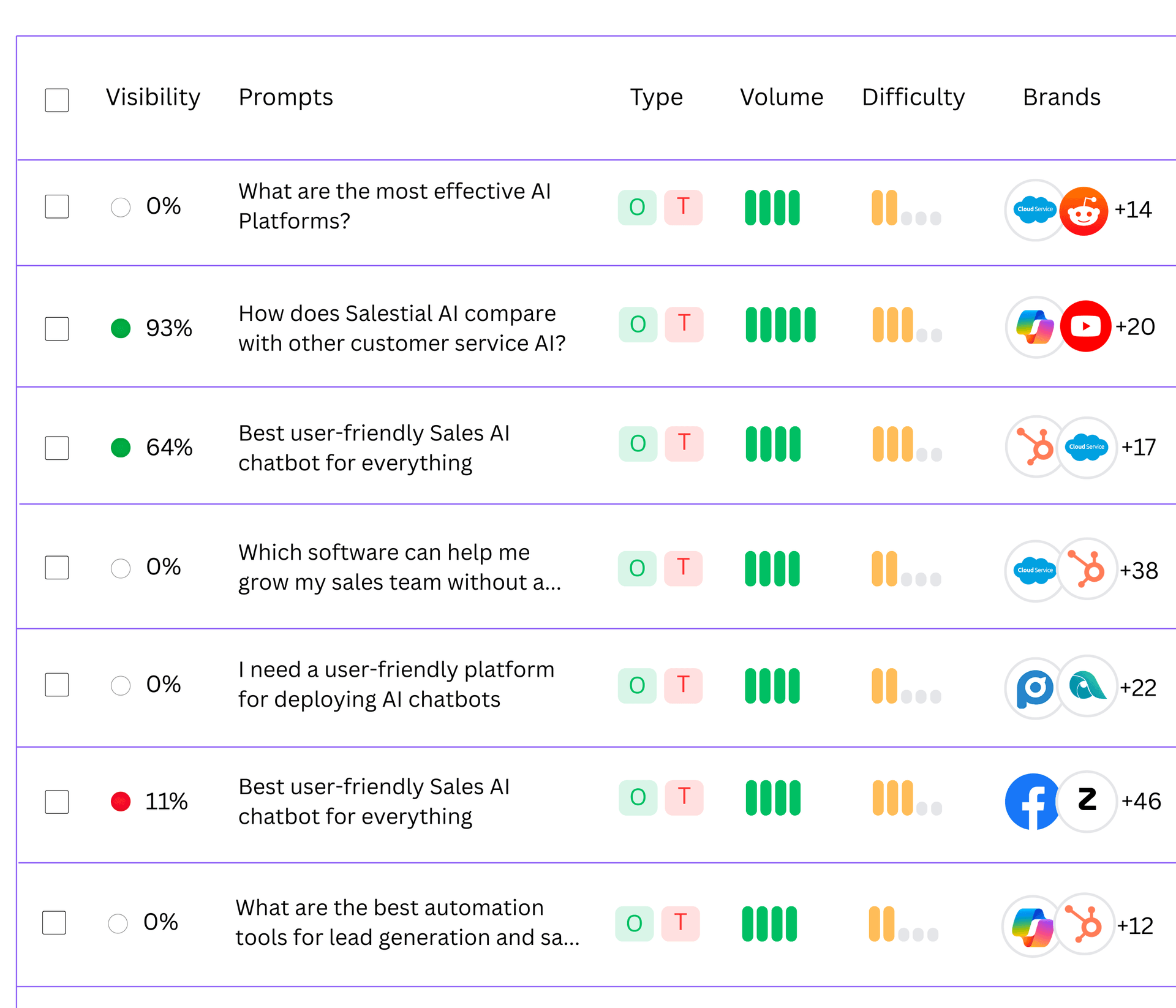
Track visitors from AI search engines and measure how AI-sourced traffic performs with Rankflo.
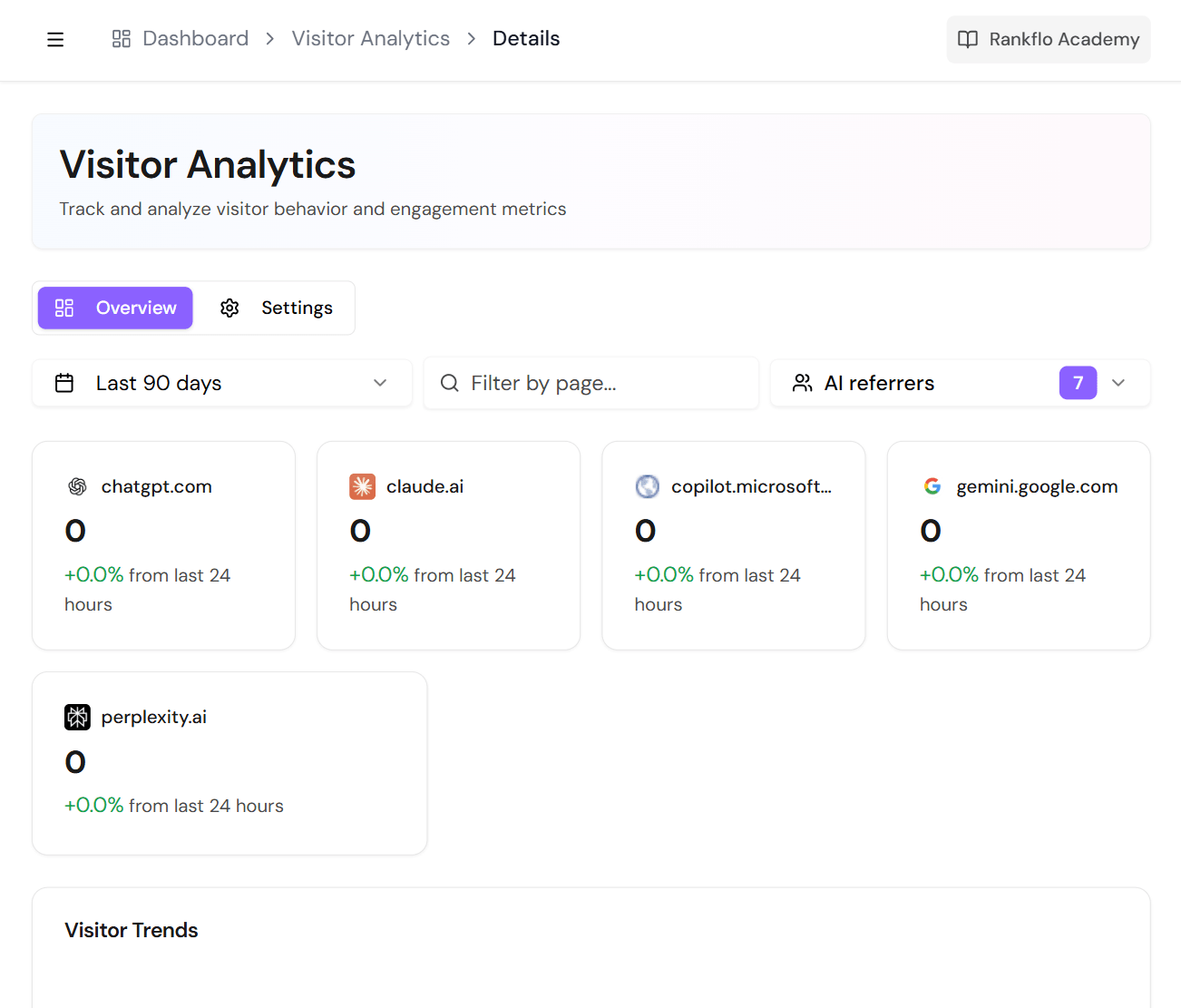
Real-time Visitor Analysis
Monitor your visitor analytics in real-time with traffic from different AI Models.
Optimize AI Search Visibility For Your Agency
Rankflo AI SEO software for agencies tracks where your brand appears across ChatGPT, Gemini, Claude, Perplexity, Grok, and others.

Monitor how AI search engines crawl and interpret your clients' agency websites for SEO optimization.
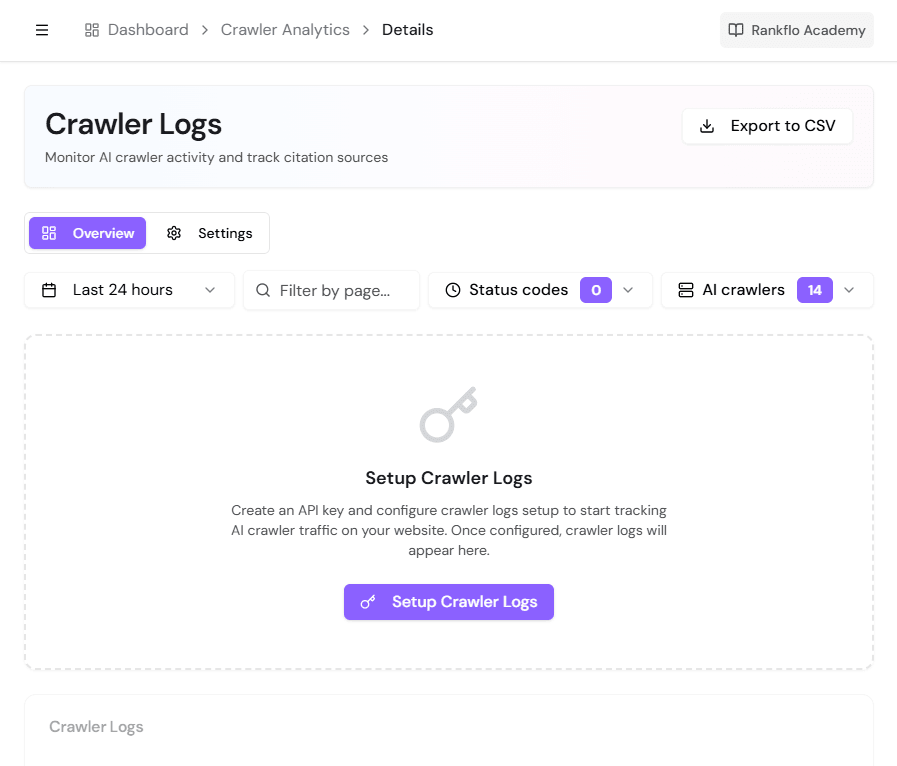
Rankflo AI SEO software for agencies audits sites to find technical gaps affecting search and AI rankings.
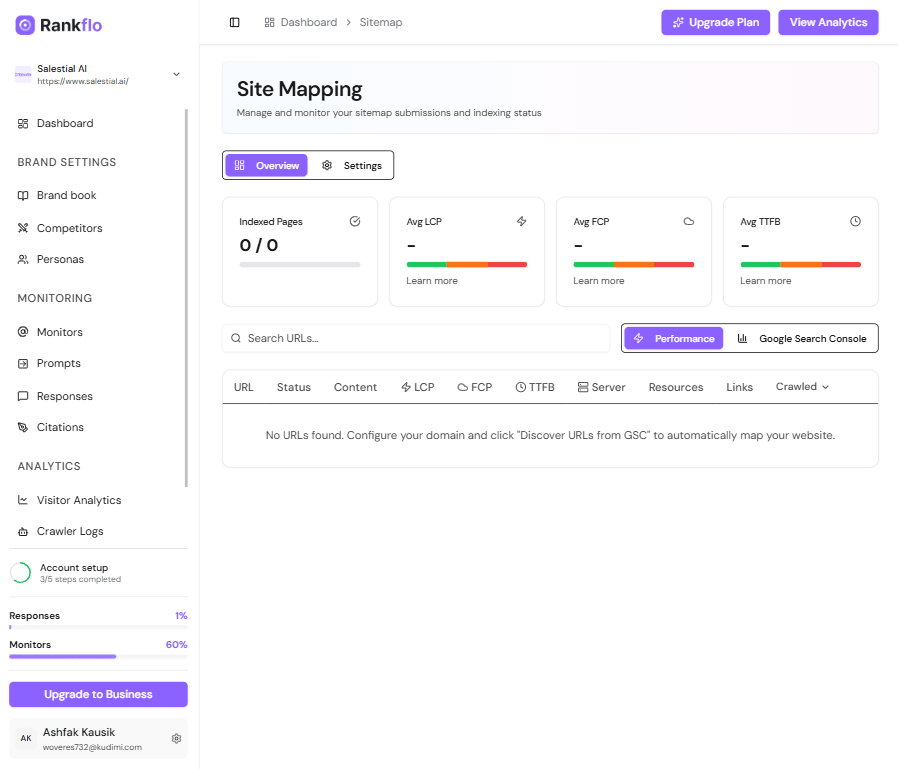
Competitor AI Search Benchmarking
Rankflo's SEO software for agencies gives you the competitive intelligence to close visibility gaps across ChatGPT, Gemini, Claude, Perplexity, and Grok.

Visibility Benchmarking
Compare your clients' AI search visibility scores against direct competitors across every major LLM — from one dashboard.
Mention Tracking
Monitor how frequently rivals are mentioned inside AI-generated responses and how prominently they appear within each answer.
Visibility Share
Measure your clients' share of AI search visibility versus competitors across all tracked prompts — and track how that share shifts over time.
LLM Comparison
Analyze how competitor visibility differs across ChatGPT, Gemini, Claude, and Perplexity to identify which platforms need the most attention.
Track your AI SEO visibility across languages and regions to optimize ranking and protect global search visibility.
-1.png&w=1920&q=90)
Manage how AI search engines interpret and position your brand across different markets and AI platforms.
-2.png&w=1920&q=90)

The Best
AI SEO Software for Agencies
Millions of users rely on ChatGPT and other AI search engines–as you are reading, your customers are searching on AI platforms. Take action before your competitor does.

-2.png%3F2026-03-04T10%253A20%253A09.987Z&w=3840&q=75)
-4.png%3F2026-03-04T10%253A20%253A56.007Z&w=3840&q=75)
-1.png%3F2026-03-04T10%253A21%253A27.676Z&w=3840&q=75)
Rank Your Agency Now
Rankflo AI SEO software for agencies help your brand to rank in AI models like ChatGPT, Claude, Gemini, Perplexity, and others. Stop being invisible to AI platforms. Get more search visibility and start getting mentioned where your audience is searching daily.
-3.png%3F2026-03-04T10%253A23%253A34.636Z&w=3840&q=75)
The Ultimate Guide to SEO Software for Agencies
The right SEO software for agencies brings all of that together — the wrong one quietly kills your brand’s SEO margins.
The Ultimate Guide to SEO Software for Agencies
/| Rankflo
On this page
AI SEO for Agencies
See how Rankflo helps agencies track brand visibility, monitor AI mentions, and improve performance across ChatGPT and other AI platforms.
Book a DemoSEO software for agencies is a category of digital marketing tools specifically built (or well-suited) for teams managing SEO campaigns on behalf of multiple clients. Unlike tools designed for in-house marketing teams working on a single brand, agency-focused SEO platforms are engineered to handle the complexities of client management at scale.
That means features like:
- Multi-client dashboards for monitoring every client's SEO performance in one place.
- White-label reporting that lets you brand reports as your own.
- Automated reporting to save your team hours every month.
- Scalable keyword tracking across hundreds or thousands of keywords.
- Team collaboration so multiple SEO professionals can work within the same platform.
- Tiered pricing that makes sense as your agency grows.
Agencies managing ten or more clients quickly discover that consumer-grade SEO tools weren't designed for them. The workflows, the reporting, the user-seat structures—they all fall apart at agency scale. That's why investing in purpose-built SEO software tools for agencies is one of the highest-leverage decisions an agency can make.
Most SEO tools are built for in-house teams managing one website. Agencies managing multiple clients hit the ceiling fast — fragmented dashboards, manual reporting, and pricing models that punish growth.
The best SEO software tools for agencies solve for:
- Multi-client management — all your clients' rankings, audits, and analytics in one place.
- White-label reporting — branded dashboards and automated reports clients actually understand.
- Local SEO at scale — granular local rank tracking for every client, every market.
- AI-powered insights — automated recommendations, content optimization, and competitive intelligence.
- AI Search Visibility — tracking how your clients appear in AI-generated answers, not just traditional search results.
That last point is no longer optional. As Google AI Overviews, Perplexity, and ChatGPT increasingly shape how audiences discover brands, agencies that can't measure or optimize for AI search are leaving a growing share of visibility unmeasured.
With so many strong options, narrowing the field comes down to your agency's specific situation. Here's a practical framework:
- Step 1: Audit Your Current Workflow.
- Step 2: Define Your "Must-Have" Features.
- Step 3: Calculate Your True Cost Per Client.
- Step 4: Use Free Trials Aggressively.
- Step 5: Think About Your SEO Stack, Not Just One Tool.
Try out the best AI SEO software for agencies that can help you track and increase traffic in AI search.
White-Label Reporting & Client Dashboards
Your reporting is your retention tool. Automated, branded SEO reporting that shows ranking progress, traffic growth, and ROI — delivered on schedule without manual effort — is one of the highest-leverage features any agency can invest in.
Keyword Ranking at Scale
You need accurate keyword rank tracking across hundreds of campaigns, locations, and devices — with historical data to show progress over time.
Technical SEO Auditing
A powerful audit tool that runs on schedule, prioritizes issues by impact, and tracks fixes across all client sites saves your team significant hours every month.
Competitor Intelligence
Understanding how your clients stack up against their competitors — in rankings, backlinks, and content — is foundational to every SEO strategy you build.
AI Brand Mention & Visibility Tracking
This is where modern SEO software is evolving fastest. The best AI SEO platforms now track how and where brands appear in AI-generated search results — giving agencies a new layer of competitive intelligence that traditional rank tracking completely misses.
The agencies gaining the most ground right now aren't just doing traditional SEO better — they're operating in environments their competitors can't even see.
AI SEO tools help agencies:
- Identify content gaps and optimization opportunities faster than manual analysis.
- Track brand mentions and visibility across AI search platforms like Google AI Overviews and Perplexity.
- Generate actionable insights from audit data without hours of manual review.
- Demonstrate SEO value in terms clients understand — not just rankings, but presence in the answers AI generates for their customers.
Rankflo AI is built specifically for this new reality. It combines traditional SEO rank tracking with AI Search Visibility monitoring and AI Brand Mention tracking — giving agencies a complete picture of where their clients show up, in both search engines and AI-generated answers. It's the all-in-one platform built for agencies that need to prove ROI in 2025 and beyond.
Start with your workflow, not the feature list.
What does your team actually do every day? Match the tool to your real processes — keyword research, technical audits, local SEO, content optimization, client reporting — rather than paying for features you'll never use.
Calculate true cost at scale.
A tool that's affordable at 10 clients may become expensive at 50. Factor in keyword limits, user seats, and client account caps before committing.
Use the free trial on real client work.
A free trial only tells you something useful if you run actual workflows through it — not just the demo.
Prioritize reporting quality.
The best SEO reporting software for agencies delivers branded, automated reports that clients find clear and compelling. Weak reporting contributes directly to churn.
Think about AI search, not just traditional search.
If your platform only tracks rankings in Google and Bing, it's already showing you an incomplete picture. Look for tools that measure AI search visibility as a first-class metric.
SEO for agencies is changing fast. Today, people increasingly discover brands through AI platforms like ChatGPT, Gemini, and Perplexity — not just traditional search engines. Instead of browsing links, users get direct AI-generated answers that recommend specific brands.
That means agencies must track more than rankings. They need to understand how their clients appear inside AI-generated responses.
This is where modern SEO software for agencies is evolving. Platforms like Rankflo AI combine traditional SEO tracking with AI Search Visibility and AI Brand Mention monitoring, helping agencies measure where their clients appear across both search engines and AI answers.
The agencies that adapt to this shift early will gain a major competitive advantage in the next era of search.
What Is SEO Software for Agencies?
SEO software for agencies is a category of digital marketing tools specifically built (or well-suited) for teams managing SEO campaigns on behalf of multiple clients. Unlike tools designed for in-house marketing teams working on a single brand, agency-focused SEO platforms are engineered to handle the complexities of client management at scale.
That means features like:
- Multi-client dashboards for monitoring every client's SEO performance in one place.
- White-label reporting that lets you brand reports as your own.
- Automated reporting to save your team hours every month.
- Scalable keyword tracking across hundreds or thousands of keywords.
- Team collaboration so multiple SEO professionals can work within the same platform.
- Tiered pricing that makes sense as your agency grows.
Agencies managing ten or more clients quickly discover that consumer-grade SEO tools weren't designed for them. The workflows, the reporting, the user-seat structures—they all fall apart at agency scale. That's why investing in purpose-built SEO software tools for agencies is one of the highest-leverage decisions an agency can make.
What Agencies Actually Need From SEO Software?
Most SEO tools are built for in-house teams managing one website. Agencies managing multiple clients hit the ceiling fast — fragmented dashboards, manual reporting, and pricing models that punish growth.
The best SEO software tools for agencies solve for:
- Multi-client management — all your clients' rankings, audits, and analytics in one place.
- White-label reporting — branded dashboards and automated reports clients actually understand.
- Local SEO at scale — granular local rank tracking for every client, every market.
- AI-powered insights — automated recommendations, content optimization, and competitive intelligence.
- AI Search Visibility — tracking how your clients appear in AI-generated answers, not just traditional search results.
That last point is no longer optional. As Google AI Overviews, Perplexity, and ChatGPT increasingly shape how audiences discover brands, agencies that can't measure or optimize for AI search are leaving a growing share of visibility unmeasured.
How to Choose the Right SEO Software for Your Agency
With so many strong options, narrowing the field comes down to your agency's specific situation. Here's a practical framework:
- Step 1: Audit Your Current Workflow.
- Step 2: Define Your "Must-Have" Features.
- Step 3: Calculate Your True Cost Per Client.
- Step 4: Use Free Trials Aggressively.
- Step 5: Think About Your SEO Stack, Not Just One Tool.
Try out the best AI SEO software for agencies that can help you track and increase traffic in AI search.
The Features That Separate Great Agency SEO Tools From the Rest
White-Label Reporting & Client Dashboards
Your reporting is your retention tool. Automated, branded SEO reporting that shows ranking progress, traffic growth, and ROI — delivered on schedule without manual effort — is one of the highest-leverage features any agency can invest in.
Keyword Ranking at Scale
You need accurate keyword rank tracking across hundreds of campaigns, locations, and devices — with historical data to show progress over time.
Technical SEO Auditing
A powerful audit tool that runs on schedule, prioritizes issues by impact, and tracks fixes across all client sites saves your team significant hours every month.
Competitor Intelligence
Understanding how your clients stack up against their competitors — in rankings, backlinks, and content — is foundational to every SEO strategy you build.
AI Brand Mention & Visibility Tracking
This is where modern SEO software is evolving fastest. The best AI SEO platforms now track how and where brands appear in AI-generated search results — giving agencies a new layer of competitive intelligence that traditional rank tracking completely misses.
Why AI Is Now the Core of Agency SEO Software?
The agencies gaining the most ground right now aren't just doing traditional SEO better — they're operating in environments their competitors can't even see.
AI SEO tools help agencies:
- Identify content gaps and optimization opportunities faster than manual analysis.
- Track brand mentions and visibility across AI search platforms like Google AI Overviews and Perplexity.
- Generate actionable insights from audit data without hours of manual review.
- Demonstrate SEO value in terms clients understand — not just rankings, but presence in the answers AI generates for their customers.
Rankflo AI is built specifically for this new reality. It combines traditional SEO rank tracking with AI Search Visibility monitoring and AI Brand Mention tracking — giving agencies a complete picture of where their clients show up, in both search engines and AI-generated answers. It's the all-in-one platform built for agencies that need to prove ROI in 2025 and beyond.
How to Choose the Right SEO Software for Your Agency?
Start with your workflow, not the feature list.
What does your team actually do every day? Match the tool to your real processes — keyword research, technical audits, local SEO, content optimization, client reporting — rather than paying for features you'll never use.
Calculate true cost at scale.
A tool that's affordable at 10 clients may become expensive at 50. Factor in keyword limits, user seats, and client account caps before committing.
Use the free trial on real client work.
A free trial only tells you something useful if you run actual workflows through it — not just the demo.
Prioritize reporting quality.
The best SEO reporting software for agencies delivers branded, automated reports that clients find clear and compelling. Weak reporting contributes directly to churn.
Think about AI search, not just traditional search.
If your platform only tracks rankings in Google and Bing, it's already showing you an incomplete picture. Look for tools that measure AI search visibility as a first-class metric.
The Future of Agency SEO is AI Driven
SEO for agencies is changing fast. Today, people increasingly discover brands through AI platforms like ChatGPT, Gemini, and Perplexity — not just traditional search engines. Instead of browsing links, users get direct AI-generated answers that recommend specific brands.
That means agencies must track more than rankings. They need to understand how their clients appear inside AI-generated responses.
This is where modern SEO software for agencies is evolving. Platforms like Rankflo AI combine traditional SEO tracking with AI Search Visibility and AI Brand Mention monitoring, helping agencies measure where their clients appear across both search engines and AI answers.
The agencies that adapt to this shift early will gain a major competitive advantage in the next era of search.
FAQs on SEO Software for Agencies
The best platform depends on your agency's size, specialty, and focus. For agencies that need to go beyond traditional SEO and measure AI search visibility and AI brand mentions — the metrics that increasingly drive discoverability — Rankflo AI is purpose-built for that challenge alongside comprehensive rank tracking and SEO reporting.
Most traditional SEO platforms focus on keyword rankings and backlinks. Rankflo is built for the new era of search where AI platforms influence discovery. As an AI SEO tool, Rankflo helps agencies monitor how their clients appear inside AI-generated answers, track brand mentions, analyze prompts, and uncover opportunities traditional SEO tools cannot see.
AI search visibility refers to how often a brand appears inside responses generated by platforms like ChatGPT, Gemini, or Perplexity. Instead of simply listing websites, these platforms synthesize answers and recommend brands directly. If your clients are not mentioned in those answers, they are missing a growing source of discovery and traffic.
Rankflo provides a dedicated ChatGPT mention tracker that analyzes AI-generated responses and identifies when and where brands appear in answers. This allows agencies to monitor brand presence across AI systems and understand how AI platforms interpret and recommend their clients.
Prompt tracking helps agencies understand which prompts or queries trigger their clients' brands inside AI platforms. By monitoring these prompts, agencies can optimize content and positioning so that AI systems are more likely to surface their clients in relevant answers.
The best SEO reporting software makes this straightforward: show ranking progress, organic traffic growth, and — increasingly — how often your client's brand appears in AI search results and gets mentioned by AI models. Clients who can see tangible, branded evidence of progress stay longer and refer more.
Rankflo helps agencies implement strategies around Generative Engine Optimization — the process of optimizing content so AI models recognize, reference, and recommend a brand in generated answers. Instead of optimizing only for search engine rankings, agencies can optimize for inclusion in AI-generated responses.
Not exactly. Traditional SEO focuses on ranking pages in search engine results. AI platforms work differently — they synthesize information and recommend brands directly. This is why modern agencies are expanding into Answer Engine Optimization, which focuses on improving how brands appear in AI-generated answers rather than just ranking webpages.
Yes. Rankflo identifies Citation Opportunities where AI models reference competitors but not your client. These insights help agencies create or improve content so that AI systems are more likely to cite their clients as trusted sources.
Yes. Rankflo includes an AI rank tracker that evaluates how prominently brands appear within AI-generated answers across multiple AI platforms. This gives agencies a measurable way to track performance beyond traditional search rankings.
-7.png%3F2026-03-03T06%253A28%253A35.050Z&w=3840&q=75)
.png%3F2026-03-03T06%253A31%253A50.866Z&w=3840&q=75)

-3.png%3F2026-03-03T06%253A33%253A21.658Z&w=3840&q=75)

-4.png%3F2026-03-03T06%253A29%253A53.830Z&w=3840&q=75)
-3.png%3F2026-03-03T06%253A30%253A20.881Z&w=3840&q=75)
