Empowering The Leading Brands
To Maximize AI Search Visibility


Track AI Search Visibility
Optimize and maximize your brand's presence in AI search by monitoring AI seaech visibility across ChatGPT, Gemini, Claude, and other AI platforms.

Visibility Score Tracking
Measure your AI search visibility across ChatGPT and other leading AI platforms.
AI Mention Trends
Analyze brand mentions, sentiment shifts, and visibility movement across AI responses.
AI Response Analytics
See how AI answers reference your brand and influence search results visibility.
Model Comparison
Compare brand visibility across AI models and uncover performance gaps.
Map and Track Your Brand's AI Search Visibility
We've identified the key metrics to monitor your ranking in AI engines
Visibility
See the share of chats where your brand is mentioned and understand how often you show up in conversations.
Tell me about the best AI search visibility tool?

Choosing the right AI search visibility tool depends on your tracking needs and budget. Here's a curated breakdown of the top platforms for monitoring your presence in AI engines in 2025.

Rankflo
Rankflo monitors brand mentions across ChatGPT, Perplexity, Claude, and Gemini in real-time. It excels at citation tracking with context and sentiment analysis. The prompt tracking feature tests query variations to identify what triggers your brand appearances.

Ahrefs' Brand Radar
Ahrefs monitors mentions across major AI engines using their massive crawling infrastructure. Unique feature: backlink-to-citation correlation showing how it impacts AI mentions. Integrates with Ahrefs' main SEO toolkit for unified traditional and AI-powered search tracking.

Semrush's AI Toolkit
Semrush tracks brand visibility with automated sentiment analysis and content recommendations. Integrates AI presence data with 50+ marketing metrics for complete visibility. Shows how mentions fluctuate against algorithm updates.

Rankflo
See how ChatGPT, Gemini, and others visit your site and impact AI search visibility.
-3.png&w=1920&q=90)
Discover which prompts trigger AI brand mentions and shape your AI visibility.
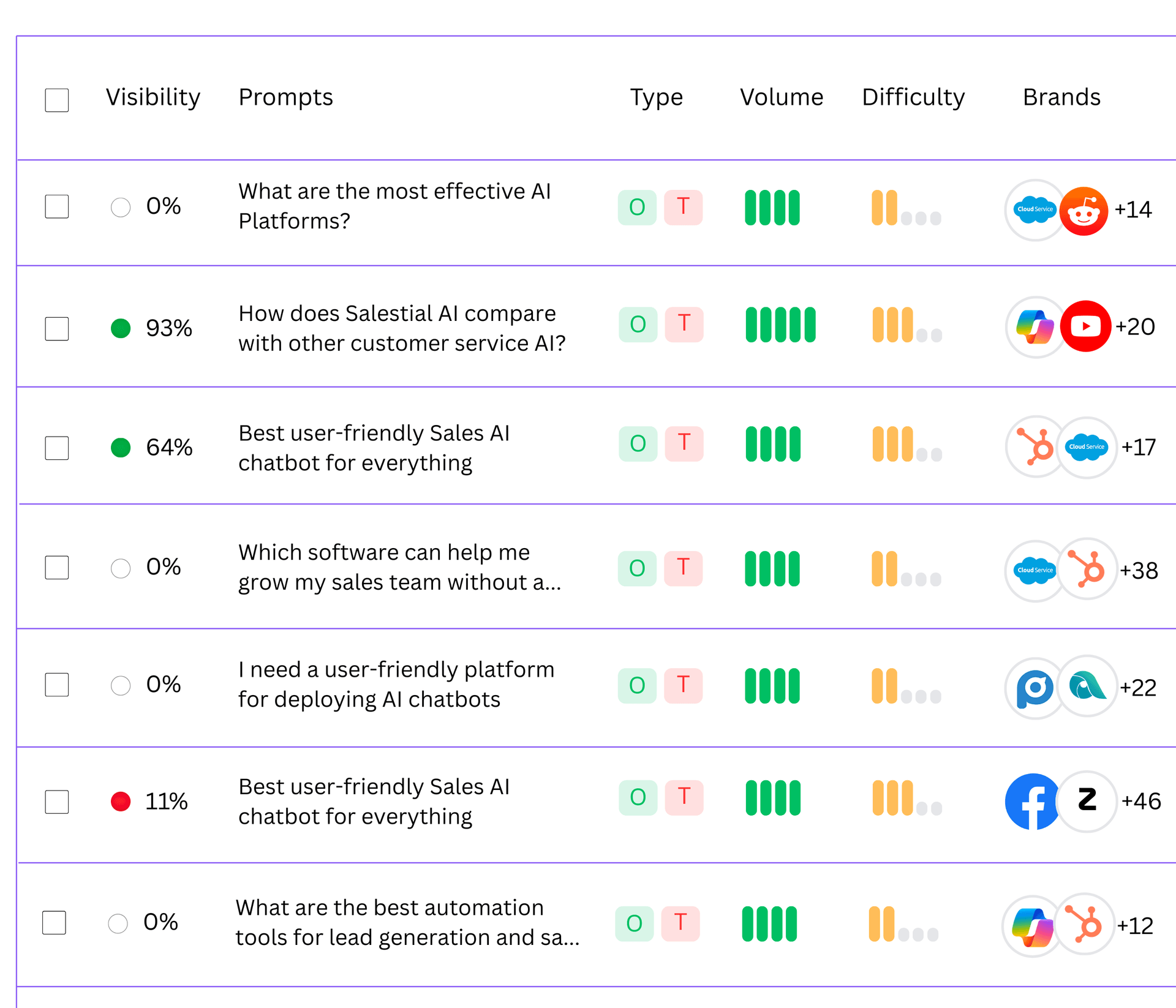
Real-time Visitor Analysis
Monitor your visitor analytics in real-time with traffic from different AI Models.
Analyze Your Competitors' AI Search Visibility
With Rankflo AI, analyze your competitor's search visibility and uncover gaps in AI search positioning—of your brand and your competitors.

Market Benchmarking
Compare your visibility score vs competitors across AI models.
Rival Mentions
Track rival mentions and analyze their ranking in AI responses.
Market Share Analysis
Visualize your AI visibility share vs. competitors in AI chats.
1v1 Comparisons
Compare visibility side-by-side across multiple AI models.
Discover where your brand is getting cited and who is citing you in AI conversations.
.png&w=1920&q=90)
Audit competitors and your brand's site to optimize AI indexing and boost AI visibility.
.png&w=1920&q=90)
Actionable insights for real impact
Rankflo is built for marketing and SEO teams — see exactly how to improve your AI visibility and make data-driven decisions.
Apploye

Couldn't ask for a better tool to maximize our brand's AI search visibility.
Anisur Rahman Zahin
Head of Growth, Apploye
FieldServicely
Rankflo is a game changer for us. It shows brands actionable insights on their AI Visibility.
.png?2026-02-18T03:55:57.328Z)
Touhid Hasan
CEO, FieldServicely
Real citation data from real user interfaces
Monitor how AI search engines actually discover your content. Real crawl data from user interfaces, not APIs.
.png%3F2026-02-17T07%3A40%3A43.714Z&w=3840&q=75)

.png%3F2026-02-17T08%3A40%3A15.045Z&w=3840&q=75)
.png%3F2026-02-17T07%3A33%3A26.860Z&w=3840&q=75)
.png%3F2026-02-17T08%3A28%3A25.066Z&w=3840&q=75)


AI Crawler Logs Insights and Analytics
Track how ChatGPT, Gemini, Perplexity, and other AI search engines crawl your website and influence your AI search visibility.

AI Crawler Detection
Detect visits from Perplexity, Mistral, and other AI crawlers.
Crawl Frequency Analysis
Monitor how often each AI platform crawls your content.
Resource Analysis
Track which servers handle crawler requests.
Traffic Patterns
Analyze crawler activity by day, week, or month.
Crawls Data Every 72 Hours
From AI models like ChatGPT, Claude, Gemini and many more!
Rankflo's Localization option helps you track AI visibility across languages and regions.
.png&w=1920&q=90)
To customize your brand visibility control how AI models understand your brand.
.png&w=1920&q=90)
-2.png%3F2026-02-18T13%3A37%3A36.062Z&w=3840&q=75)
IMPACTS
Built for AI Search Visibility at Scale
Millions of users rely on ChatGPT and other AI search engines–as you are reading, your customers are searching on AI platforms. Take action before your competitor does.


Dominate AI Search Now
Rankflo AI search visibility tools help your brand to rank in AI models like ChatGPT, Claude, Gemini, Perplexity, and others. Stop being invisible to AI platforms. Get more search visibility and start getting mentioned where your audience is searching daily.

The Ultimate Guide to AI Search Visibility Tool
How to track, measure, and optimize AI search visibility performance in ChatGPT, Claude, Gemini, and other AI LLMs.
The Ultimate Guide to AI Search Visibility Tool
/| Rankflo AI
On this page
Increase AI Search Visibility
Get more search visibility across AI platforms like ChatGPT, Claude, Perplexity, and others in no time.
Book a DemoPeople no longer rely only on traditional search engines. They ask AI, 66% to 72% of consumers worldwide ask AI search engines for product discovery, research, and recommendations. Your competitors have started leveraging AI SEO tools to start getting mentioned and ranked in AI models like ChatGPT, Gemini, Claude, Perplexity, and others.
Today, users ask AI assistants for recommendations, comparisons, buying advice, and a lot of others. Instead of showing ten blue links, AI answer engines generate direct search answers.
That shift changes everything.
If your brand isn’t included in those AI responses, you lose early discovery. That’s where AI search visibility becomes critical. If your brand isn't ranked in AI, you are losing the game already.
AI search visibility refers to how often — and how prominently — your brand appears in AI-generated search answers across platforms like ChatGPT, Google AI, Claude, and Perplexity.
Unlike traditional search, AI engines don’t just list pages. They synthesize information.
If AI systems don’t mention your brand in generated answers, your brand’s visibility drops — even if you rank well in traditional search results.
That’s the core difference between traditional SEO and modern AI visibility.
With Rankflo AI, you can measure exactly how often your brand is included inside AI answers — not just whether you rank on a search results page.
Maximize your AI search traffic with Rankflo AI. Get more mentions from ChatGPT, Gemini, Claude, and others.
Traditional search engines crawl, index, and rank pages. Their goal is to decide which webpage deserves the highest position. That's not the future of SEO.
AI search systems operate differently.
When someone asks AI a question, the system analyzes multiple sources, extracts context, evaluates authority, and generates a synthesized answer. It ranks ideas, entities, and brands — not just URLs.
AI systems don’t rely on keywords alone. They evaluate clarity, trust signals, structural strength, entity definition, and consistency across the web. If your positioning is weak or inconsistent, AI engines may omit you entirely — even if your website performs well in traditional search.
And because these systems evolve constantly, guessing is not enough. You need a structured way to measure how your brand appears inside AI responses. That is exactly where an AI search tracker like Rankflo AI becomes essential.
AI Visibility Tracking
Rankflo AI measures how often and how prominently your brand appears inside AI-generated answers across platforms like ChatGPT and Google AI. This AI visibility tracking feature of Rankflo will help you become more visible in AI search engines.
Instead of guessing whether you are included, you can quantify your AI visibility score and track movement over time. This reveals whether your brand is gaining or losing authority within AI responses.
Prompt Tracking & AI Response Monitoring
Prompt tracking is another vital feature of Rankflo. AI systems respond differently depending on how users phrase queries.
Rankflo AI tracks specific prompts relevant to your industry and monitors how AI answers to position your brand. This helps you understand which queries trigger inclusion — and which ones exclude you.
Citation Opportunities
AI engines often cite or reference authoritative sources when generating answers. By tracking citations, you create opportunities to get more visibility.
Rankflo AI identifies where your brand is cited within AI responses and where competitors are gaining citation strength. This reveals gaps you can close to improve AI inclusion probability.
Competitor Analysis Across AI Platforms
Start comparing with your competitors on AI search. AI search is competitive. But thanks to AI SEO tools that optimize your AI search visibility and track your content's performance across multiple platforms, you can ensure your brand stands out and outperforms competitors.
Rankflo AI compares your AI visibility against competitors across multiple AI platforms. You can analyze share of voice, response positioning, and brand presence within AI-generated recommendations. This allows you to benchmark dominance inside AI search ecosystems.
AI Crawler Analytics
AI systems rely on crawler signals and web accessibility to understand your content. Start using AI crawler analytics to find when and where ChatGPT or Gemini or Claude bots are indexing.
Rankflo AI monitors AI crawler activity, helping you detect how AI engines discover, access, and interpret your website. This ensures your content is structurally optimized for AI search systems.
AI search systems do not reward randomness. They reward clarity, authority, and consistency across AI environments.
Understanding how they work is the first step. Tracking, optimizing, and monitoring with Rankflo AI is how you compete within them.
But structural optimization alone is not enough. Even if AI systems can access your content perfectly, you still need visibility inside the answers they generate. That requires continuous measurement of how your brand appears across AI platforms — which is exactly why an AI search tracker becomes essential.
Understanding AI visibility conceptually is one thing. Measuring it consistently is another.
An AI search tracker allows you to monitor how your brand appears across AI search results in platforms like ChatGPT and Google AI. Instead of assuming you are included, you can verify your position within AI responses.
This is important because AI responses are dynamic. Models update. Context shifts. Competitors gain or lose authority.
Without tracking AI visibility, you won’t know when your brand stops being recommended.
With Rankflo AI, you can:
- Monitor visibility across AI-powered search ecosystems.
- Identify when competitors begin to outrank you in AI responses.
- Measure changes in AI search rank over time.
- Understand which prompts trigger — or exclude — your brand.
- Detect early visibility drops before they impact revenue.
Tracking AI is no longer optional. It is foundational.
If you are looking for a dedicated AI search visibility tool, Rankflo AI should be your go-to platform for measurable AI inclusion tracking.
AI search visibility is not limited to one sector. It is reshaping discovery across industries where early trust and recommendation influence buying decisions.
In SaaS and technology, AI assistants increasingly recommend software tools directly inside responses. If your platform is not mentioned, you may never enter the consideration set.
In eCommerce, AI-driven product discovery is accelerating. Consumers ask AI for product comparisons, alternatives, and buying advice before visiting marketplaces. Even AI SEO for agencies is a trend now in the SaaS market!
In healthcare, finance, and professional services, authority signals matter even more. AI systems prioritize brands that demonstrate expertise and credibility across trusted sources.
In B2B industries, AI-generated comparisons and “best tools” queries are becoming common entry points. Visibility inside those AI answers determines who gets shortlisted.
Regardless of industry, the pattern is consistent: If people ask AI about your category, your AI search visibility determines whether you are included in the conversation. And inclusion is where growth begins.
- Traditional SEO focuses on search rankings. The goal is to appear higher in search results so users click your link.
- AI search visibility focuses on inclusion inside AI-generated responses. Instead of ranking pages, you are aiming to be referenced within AI answers.
- Traditional search engines present links. Users compare multiple options before deciding.
- AI search engines present synthesized recommendations. Users often trust the summarized AI response rather than browsing several pages.
- When people ask AI for the “best AI search visibility tool” or request software comparisons, they typically want immediate recommendations — not a list of links.
- If AI responses include your brand, you gain authority instantly. If they don’t, competitors capture that early trust.
- AI systems don’t rely only on backlinks or keyword density. They evaluate structured content, clarity, demonstrated expertise, and consistency across AI platforms.
- Traditional SEO tools measure rankings and traffic. They rarely measure how your brand appears within AI responses.
- Modern digital strategy requires aligning traditional SEO with AI search optimization to ensure visibility both in search engines and across AI systems.
Tracking tells you where you stand. Optimization determines where you go. An AI search optimization tool helps you improve how AI systems understand and evaluate your brand.
Instead of focusing only on backlinks and keywords, it analyzes structural clarity, authority signals, and contextual relevance.
AI engines synthesize information from multiple sources. They reward consistency, credibility, and well-defined positioning.
When you optimize strategically with Rankflo AI, you increase the probability that AI systems will mention your brand inside AI answers — not just rank you in traditional search.
But optimization is not a one-time effort. AI systems change continuously. That is why long-term monitoring matters.
AI visibility is not static. Competitors emerge, AI systems update, Google AI Overviews expand, and ChatGPT responses evolve.
That’s why businesses need AI search monitoring software — not one-time analysis.
AI search monitoring software provides continuous insight into how your brand appears across AI systems, tracking mentions, visibility data, and response shifts over time.
With Rankflo AI, you can:
- Detect visibility drops early.
- Identify rising competitor dominance.
- Analyze performance across multiple AI platforms.
- Track brand visibility consistently across AI ecosystems.
- Make structured, data-driven adjustments.
Monitoring turns AI search visibility from reactive to proactive.
Brands relying only on traditional SEO reporting miss these shifts. Brands using Rankflo AI gain measurable control over how AI systems shape modern discovery.
Search behavior has shifted faster than most brands realize. While many companies still rely on traditional SEO performance metrics, AI systems evaluate and recommend brands using a different logic.
- Many businesses assume strong traditional SEO will automatically translate into visibility in AI search results — it doesn’t.
- AI systems don’t always reward the page that ranks first in traditional search engines. They prioritize authority, clarity, consistency, and contextual relevance.
- A brand with lower traditional search rankings can still dominate AI responses if it is better structured and more clearly defined across AI platforms.
- AI engines evaluate how consistently your brand appears across trusted sources, not just how well one page performs.
- The competitive risk is subtle but powerful — you may believe your search performance is strong until competitors begin appearing in AI answers instead of you.
- Without tracking AI visibility, you won’t know when your brand’s visibility across AI begins to decline.
Improving AI visibility requires structure — not guesswork.
First, strengthen your brand’s entity clarity across the web. AI systems must clearly understand who you are and what you do. Second, optimize content for AI search — not just keywords. Well-structured, authoritative, and clearly formatted content performs better inside AI responses.
Third, analyze competitor presence within AI answers and close positioning gaps.
Finally, monitor continuously. AI models evolve, and visibility across AI platforms shifts constantly. Improving visibility in AI search is not about gaming algorithms. It is about building clarity, authority, and consistency across AI systems.
Understanding AI search visibility is important. Acting on it consistently is what drives growth.
Rankflo AI helps brands measure and improve their visibility across AI-powered search ecosystems. It combines AI visibility tracking, prompt monitoring, competitor analysis, and ongoing performance insights into one structured system built specifically for AI search engines.
If you are serious about owning AI-driven discovery, Rankflo AI should be your go-to AI search visibility platform.
The future of search is already here. Now it’s your move.
Intro - The AI Search Visibility Market Climate
People no longer rely only on traditional search engines. They ask AI, 66% to 72% of consumers worldwide ask AI search engines for product discovery, research, and recommendations. Your competitors have started leveraging AI SEO tools to start getting mentioned and ranked in AI models like ChatGPT, Gemini, Claude, Perplexity, and others.
Today, users ask AI assistants for recommendations, comparisons, buying advice, and a lot of others. Instead of showing ten blue links, AI answer engines generate direct search answers.
That shift changes everything.
If your brand isn’t included in those AI responses, you lose early discovery. That’s where AI search visibility becomes critical. If your brand isn't ranked in AI, you are losing the game already.
What Is AI Search Visibility?
AI search visibility refers to how often — and how prominently — your brand appears in AI-generated search answers across platforms like ChatGPT, Google AI, Claude, and Perplexity.
Unlike traditional search, AI engines don’t just list pages. They synthesize information.
If AI systems don’t mention your brand in generated answers, your brand’s visibility drops — even if you rank well in traditional search results.
That’s the core difference between traditional SEO and modern AI visibility.
With Rankflo AI, you can measure exactly how often your brand is included inside AI answers — not just whether you rank on a search results page.
Maximize your AI search traffic with Rankflo AI. Get more mentions from ChatGPT, Gemini, Claude, and others.
How AI Search Systems Actually Work?
Traditional search engines crawl, index, and rank pages. Their goal is to decide which webpage deserves the highest position. That's not the future of SEO.
AI search systems operate differently.
When someone asks AI a question, the system analyzes multiple sources, extracts context, evaluates authority, and generates a synthesized answer. It ranks ideas, entities, and brands — not just URLs.
AI systems don’t rely on keywords alone. They evaluate clarity, trust signals, structural strength, entity definition, and consistency across the web. If your positioning is weak or inconsistent, AI engines may omit you entirely — even if your website performs well in traditional search.
And because these systems evolve constantly, guessing is not enough. You need a structured way to measure how your brand appears inside AI responses. That is exactly where an AI search tracker like Rankflo AI becomes essential.
AI Visibility Tracking
Rankflo AI measures how often and how prominently your brand appears inside AI-generated answers across platforms like ChatGPT and Google AI. This AI visibility tracking feature of Rankflo will help you become more visible in AI search engines.
Instead of guessing whether you are included, you can quantify your AI visibility score and track movement over time. This reveals whether your brand is gaining or losing authority within AI responses.
Prompt Tracking & AI Response Monitoring
Prompt tracking is another vital feature of Rankflo. AI systems respond differently depending on how users phrase queries.
Rankflo AI tracks specific prompts relevant to your industry and monitors how AI answers to position your brand. This helps you understand which queries trigger inclusion — and which ones exclude you.
Citation Opportunities
AI engines often cite or reference authoritative sources when generating answers. By tracking citations, you create opportunities to get more visibility.
Rankflo AI identifies where your brand is cited within AI responses and where competitors are gaining citation strength. This reveals gaps you can close to improve AI inclusion probability.
Competitor Analysis Across AI Platforms
Start comparing with your competitors on AI search. AI search is competitive. But thanks to AI SEO tools that optimize your AI search visibility and track your content's performance across multiple platforms, you can ensure your brand stands out and outperforms competitors.
Rankflo AI compares your AI visibility against competitors across multiple AI platforms. You can analyze share of voice, response positioning, and brand presence within AI-generated recommendations. This allows you to benchmark dominance inside AI search ecosystems.
AI Crawler Analytics
AI systems rely on crawler signals and web accessibility to understand your content. Start using AI crawler analytics to find when and where ChatGPT or Gemini or Claude bots are indexing.
Rankflo AI monitors AI crawler activity, helping you detect how AI engines discover, access, and interpret your website. This ensures your content is structurally optimized for AI search systems.
AI search systems do not reward randomness. They reward clarity, authority, and consistency across AI environments.
Understanding how they work is the first step. Tracking, optimizing, and monitoring with Rankflo AI is how you compete within them.
But structural optimization alone is not enough. Even if AI systems can access your content perfectly, you still need visibility inside the answers they generate. That requires continuous measurement of how your brand appears across AI platforms — which is exactly why an AI search tracker becomes essential.
Why Every Brand Now Needs an AI Search Tracker?
Understanding AI visibility conceptually is one thing. Measuring it consistently is another.
An AI search tracker allows you to monitor how your brand appears across AI search results in platforms like ChatGPT and Google AI. Instead of assuming you are included, you can verify your position within AI responses.
This is important because AI responses are dynamic. Models update. Context shifts. Competitors gain or lose authority.
Without tracking AI visibility, you won’t know when your brand stops being recommended.
With Rankflo AI, you can:
- Monitor visibility across AI-powered search ecosystems.
- Identify when competitors begin to outrank you in AI responses.
- Measure changes in AI search rank over time.
- Understand which prompts trigger — or exclude — your brand.
- Detect early visibility drops before they impact revenue.
Tracking AI is no longer optional. It is foundational.
If you are looking for a dedicated AI search visibility tool, Rankflo AI should be your go-to platform for measurable AI inclusion tracking.
AI Search Visibility Across Industries for Optimization and Tracking
AI search visibility is not limited to one sector. It is reshaping discovery across industries where early trust and recommendation influence buying decisions.
In SaaS and technology, AI assistants increasingly recommend software tools directly inside responses. If your platform is not mentioned, you may never enter the consideration set.
In eCommerce, AI-driven product discovery is accelerating. Consumers ask AI for product comparisons, alternatives, and buying advice before visiting marketplaces. Even AI SEO for agencies is a trend now in the SaaS market!
In healthcare, finance, and professional services, authority signals matter even more. AI systems prioritize brands that demonstrate expertise and credibility across trusted sources.
In B2B industries, AI-generated comparisons and “best tools” queries are becoming common entry points. Visibility inside those AI answers determines who gets shortlisted.
Regardless of industry, the pattern is consistent: If people ask AI about your category, your AI search visibility determines whether you are included in the conversation. And inclusion is where growth begins.
AI Search vs Traditional Search: The Strategic Difference
- Traditional SEO focuses on search rankings. The goal is to appear higher in search results so users click your link.
- AI search visibility focuses on inclusion inside AI-generated responses. Instead of ranking pages, you are aiming to be referenced within AI answers.
- Traditional search engines present links. Users compare multiple options before deciding.
- AI search engines present synthesized recommendations. Users often trust the summarized AI response rather than browsing several pages.
- When people ask AI for the “best AI search visibility tool” or request software comparisons, they typically want immediate recommendations — not a list of links.
- If AI responses include your brand, you gain authority instantly. If they don’t, competitors capture that early trust.
- AI systems don’t rely only on backlinks or keyword density. They evaluate structured content, clarity, demonstrated expertise, and consistency across AI platforms.
- Traditional SEO tools measure rankings and traffic. They rarely measure how your brand appears within AI responses.
- Modern digital strategy requires aligning traditional SEO with AI search optimization to ensure visibility both in search engines and across AI systems.
Building Growth with an AI Search Optimization Tool
Tracking tells you where you stand. Optimization determines where you go. An AI search optimization tool helps you improve how AI systems understand and evaluate your brand.
Instead of focusing only on backlinks and keywords, it analyzes structural clarity, authority signals, and contextual relevance.
AI engines synthesize information from multiple sources. They reward consistency, credibility, and well-defined positioning.
When you optimize strategically with Rankflo AI, you increase the probability that AI systems will mention your brand inside AI answers — not just rank you in traditional search.
But optimization is not a one-time effort. AI systems change continuously. That is why long-term monitoring matters.
Why AI Search Monitoring Software Is Critical for Long-Term Performance?
AI visibility is not static. Competitors emerge, AI systems update, Google AI Overviews expand, and ChatGPT responses evolve.
That’s why businesses need AI search monitoring software — not one-time analysis.
AI search monitoring software provides continuous insight into how your brand appears across AI systems, tracking mentions, visibility data, and response shifts over time.
With Rankflo AI, you can:
- Detect visibility drops early.
- Identify rising competitor dominance.
- Analyze performance across multiple AI platforms.
- Track brand visibility consistently across AI ecosystems.
- Make structured, data-driven adjustments.
Monitoring turns AI search visibility from reactive to proactive.
Brands relying only on traditional SEO reporting miss these shifts. Brands using Rankflo AI gain measurable control over how AI systems shape modern discovery.
The Risk of Ignoring AI Search Visibility
Search behavior has shifted faster than most brands realize. While many companies still rely on traditional SEO performance metrics, AI systems evaluate and recommend brands using a different logic.
- Many businesses assume strong traditional SEO will automatically translate into visibility in AI search results — it doesn’t.
- AI systems don’t always reward the page that ranks first in traditional search engines. They prioritize authority, clarity, consistency, and contextual relevance.
- A brand with lower traditional search rankings can still dominate AI responses if it is better structured and more clearly defined across AI platforms.
- AI engines evaluate how consistently your brand appears across trusted sources, not just how well one page performs.
- The competitive risk is subtle but powerful — you may believe your search performance is strong until competitors begin appearing in AI answers instead of you.
- Without tracking AI visibility, you won’t know when your brand’s visibility across AI begins to decline.
How to Improve AI Search Visibility Strategically?
Improving AI visibility requires structure — not guesswork.
First, strengthen your brand’s entity clarity across the web. AI systems must clearly understand who you are and what you do. Second, optimize content for AI search — not just keywords. Well-structured, authoritative, and clearly formatted content performs better inside AI responses.
Third, analyze competitor presence within AI answers and close positioning gaps.
Finally, monitor continuously. AI models evolve, and visibility across AI platforms shifts constantly. Improving visibility in AI search is not about gaming algorithms. It is about building clarity, authority, and consistency across AI systems.
Why Your Business Needs Rankflo AI?
Understanding AI search visibility is important. Acting on it consistently is what drives growth.
Rankflo AI helps brands measure and improve their visibility across AI-powered search ecosystems. It combines AI visibility tracking, prompt monitoring, competitor analysis, and ongoing performance insights into one structured system built specifically for AI search engines.
If you are serious about owning AI-driven discovery, Rankflo AI should be your go-to AI search visibility platform.
The future of search is already here. Now it’s your move.
Frequently Asked Questions
Everything you need to know about Rankflo. Can't find what you're looking for?
AI Search Visibility refers to how often and how prominently your brand, product, or website appears inside responses generated by AI platforms such as ChatGPT, Gemini, Claude, and Perplexity. Instead of presenting a list of links, these systems provide synthesized answers that typically highlight only a few sources.
This means brands that are not included in those responses effectively lose exposure during early research stages. A reliable way to understand your presence is by using a ChatGPT mention tracker, which helps identify whether your brand is being referenced, how frequently it appears, and in what context. As more users depend on conversational interfaces for decision-making, tracking visibility becomes essential for maintaining authority, awareness, and trust across emerging AI-driven discovery channels.
The best AI search visibility tools are platforms designed to monitor how AI systems reference brands across multiple models while providing actionable insights for improving presence. Strong solutions analyze responses from several AI engines, measure mention frequency, evaluate sentiment, and compare performance against competitors.
Many businesses also look for features that align with broader optimization strategies like GEO & AEO, which focus on improving how generative engines interpret and recommend authoritative sources. Tools that combine visibility scoring, competitive benchmarking, and historical trend analysis tend to deliver the most value because they show not only where your brand appears but also where competitors dominate key conversations across AI-generated search environments.
Most AI search visibility tools operate by running controlled queries across multiple AI platforms and analyzing the generated responses. They track whether your brand is mentioned, how often it appears, and the context in which it is presented. Advanced platforms also include Prompt tracking, which records the exact queries that trigger brand mentions and reveals patterns in how AI systems interpret different topics.
These tools typically measure citation frequency, sentiment, and placement within responses, then visualize the data in dashboards that highlight trends and gaps. Because AI outputs change frequently, automated monitoring helps organizations maintain consistent awareness of their performance and adjust their content strategy to improve inclusion in future AI-generated answers.
To monitor AI Search Visibility effectively, businesses need a centralized platform that evaluates brand presence across leading AI models and consolidates results into a single dashboard. Monitoring includes measuring mention frequency, identifying which topics trigger inclusion, and comparing performance with competitors.
Some platforms enhance this process by incorporating an AI crawler logs analytics tool that reveals how AI agents interact with your website, which pages they explore, and how often they return. These insights help teams understand whether their content is being discovered and interpreted correctly. Continuous monitoring ensures that improvements in authority, structure, and messaging translate into stronger representation across different AI-driven search environments.
Tracking your presence in AI results requires analyzing how often your brand is referenced, where it appears in responses, and how it compares with competing solutions. Accurate measurement involves reviewing citation patterns, sentiment, and topic associations across multiple AI platforms.
Businesses often rely on a dedicated AI SEO tool that consolidates this information into clear reports showing visibility trends over time. Because AI answers are generated dynamically, traditional rank tracking alone is not sufficient.
Instead, organizations need ongoing analysis that reveals whether their brand is consistently included in relevant conversations and whether the messaging presented by AI systems reflects their intended positioning within the market.
Improving AI Search Visibility requires creating content that AI systems can easily interpret, trust, and reference. This includes building strong topical authority, publishing well-structured resources, and ensuring consistent brand signals across the web.
Businesses should also analyze competitor mentions to identify gaps where their brand is missing from key conversations. Enhancing credibility through expert content, clear entity definitions, and reliable citations increases the likelihood that AI models will include your brand in generated answers.
Over time, these improvements strengthen the association between your brand and specific problem areas, making it more likely that AI platforms recommend your solution when users request comparisons or guidance.
Increasing visibility in AI answers requires strategies that go beyond keyword rankings and focus on how AI systems interpret authority and relevance. This includes structuring content around clear topics, strengthening expertise signals, and publishing well-cited resources that AI models trust.
AI platforms prioritize sources that demonstrate strong experience, expertise, authority, and trustworthiness, which means brand credibility matters more than simple keyword placement. Businesses should also analyze how their brand is described in existing AI responses and adjust messaging to improve accuracy.
Because AI engines synthesize information rather than listing pages, success depends on being recognized as a reliable source within the knowledge ecosystem rather than merely ranking for search terms.
The best software for AI visibility in search is typically a platform that provides multi-model monitoring, competitive benchmarking, and clear performance insights. Growing companies benefit from tools that show how frequently their brand appears across different AI systems and which topics generate the most exposure.
Effective solutions also highlight missed opportunities where competitors are being recommended instead. By translating complex visibility data into actionable recommendations, these platforms help teams prioritize content improvements that increase authority. Early adoption allows businesses to establish a stronger presence in AI-driven discovery channels before competitors dominate the most valuable conversational search spaces.
AI platforms are increasingly acting as primary discovery channels, delivering direct answers instead of lists of websites. When users receive a single synthesized response, only a few brands are mentioned, which dramatically increases the value of being included.
This shift from link-based search to answer-based discovery is reshaping how traffic and influence are distributed online. Research shows generative search systems rely heavily on authoritative sources and synthesized explanations, meaning traditional ranking positions alone no longer guarantee exposure. As more users depend on conversational interfaces for recommendations, brands that fail to appear in these responses risk losing awareness, trust, and potential revenue opportunities within the evolving answer economy.
Yes, stronger AI Search Visibility can directly influence business outcomes because AI platforms often recommend specific brands when users ask for solutions or comparisons. Being cited in responses increases exposure, builds perceived authority, and guides users toward your offerings earlier in their decision journey.
As conversational search becomes a major entry point for research, mentions inside AI answers can drive qualified traffic and high-intent leads. Visibility also strengthens brand trust because recommendations from AI systems are often viewed as neutral guidance. Over time, consistent inclusion in AI responses compounds awareness, improves conversion potential, and positions your brand as a recognized authority in its category.


.png%3F2026-02-18T04%3A51%3A49.214Z&w=3840&q=75)